Showing posts with label books. Show all posts

Wednesday, April 14, 2010

Book: Witches Abroad

This is my first Terry Pratchett book (well, Terry Pratchett alone; I did read Good Omens, by him and Neil Gaiman). I knew a couple of things going into it: it was going to be funny, it was going to be fantasy, and that everyone adores Terry Pratchett. So how could it go wrong?

Well... it didn't!

It was a super-fun romp through Discworld, with witches Granny Weatherwax, Magrat Garlicke, and Nanny Ogg. When Magrat discovers that she is, in fact, a fairy godmother; and what's more, a fairy godmother with a mission to help fair Ella in far off Genua, the other two (slightly meddlesome, as of course the best witches would be) accompany her.

The witches must travel across Discworld. None of them have traveled much before, so they are constantly adjusting to 'foreigners.' Along the way, they fall in and out of various well-known stories. Gollum makes an appearance, as does Red Riding Hood, the wolf, Dracula, etc. They finally reach Genua (obviously modeled after New Orleans... with a bit of The Frog Prince and Cinderella thrown in for good measure) and must help Emberella ("Ella" or "Ember"), who does NOT wish to marry the prince. Unfortunately, she has TWO fairy godmothers: the good one, and the bad one. But which witch is which?

The only thing about this book is that I didn't immediately catch on that the whole thing was essentially parody after parody after parody, so at first I was like, "What is Gollum doing here?" The other thing is that sometimes this sort of humor, similar to Douglas Adams books or even Mel Brooks movies, sometimes doesn't really work for me. I don't know why... I have to be in just the right mood for this kind of playful absurdity.

I started off not in the right mood and so was unsure if the book was going to work for me, but by the time I finished the book, it was exactly what I needed. Silly and smart and playful and pun-y and joke after joke after joke. I was feeling so stressed and anxious that I really needed this sort of lighthearted, goodnatured fun.

So I ended up loving it.

With great relief.

After all, I have heard so many amazing things about Terry Pratchett and I didn't want to be the only one in the world not to "get" it! So, with a deep sigh of relief, I now include the amazing Terry Pratchett in my list of "Authors To Turn To In Times Of Need!" I am excited to read more Discworld novels.

Friday, April 09, 2010

Book: Auntie Mame

"But darling... I'm your Auntie Mame!"

Oh, who wouldn't love an Auntie Mame? I know I would. A rich, fabulous, irreverent, eccentric, idealistic, open-minded, quirky loving auntie to sweep you up and love you and concoct wild schemes and always, always come through for you... when she isn't pulling you into unfortunate escapades or making you break school rules or throwing you into inappropriate parties, that is.

(but still, you know you love every minute of it)

I've only ever seen the Rosalind Russell movie, so it was fun to read the book and have Mame a bit more fleshed out and her sharp, quirky ways elaborated upon. Mame is not only all about life's banquet (where at, she says in the movie but not the book, "most poor bastards are starving to death."), but she is about Art and all the good things life has to offer ALL people, not only the rich and fabulous. I loved that about Mame: she is open-minded and accepting to a fault (except there is NEVER a fault in that).

Even in the 1930s and 40s (the book was published in 1955), Mame fought prejudice and closed-mindedness, as excellently portrayed in the scene with young-adult Patrick's intended in-laws (where they are discussing the prospect of a Jewish family moving to the property next door):

"Buster," Auntie Mame said, "What's come over you? They're charming people. She's very dark and vivacious and one of the best cooks in..."

"I'll bet she's dark and vivacious. A greasy, thick-lipped, loud-mouthed little..."

"Oh, but you're all wrong there. Sylvia's divine, really, and Abe went to Harvard in the same class with Samuel..."

"You mean you really know these people?" Mr. Upson asked.

"But of course. He has a marvelous job with..."

"But they're Jews."

"Well, certainly they're Jews. She's related somehow to Rabbi Wise and he..."

"Can't you get it through your thick head that they're JEWS? That they want to move in right next to ME?" Mr. Upson said.

(more vile vitriol from Mr. Upson, and then...)

"Just how many Jews do you know personally, Claude?"

"I know all I want to, " he screamed. "Pushy, bossy, aggressive, loud..."

"As loud as you're being at this moment?"

"Goddamn it! I'm talking about a pack of kikes moving in and rubbing shoulders with nice people -- decent people!"

"And this is an example of your nicety? Your decency? ... I've known dozens of Jews in my life and it has also been my sorry experience to have heard quite a few gentiles who have talked about Jews as you do. I know all the adjectives -- all of them. Jews, you will tell me, are Mean, Pushy, Avaricious, Possessive, Loud, Vulgar, Garish, Bossy people. But I've yet to meet one, from the poorest pushcart vendor on First Avenue to the richest philanthropist on Fifth Avenue, who could hold a candle to you when it comes to displaying all of those qualities."

Wow. You tell him, Mame! I wanted to stand up and clap when I read this. To me, this is as good as any example of why it's so important continue to fight bigotry and ignorant hate, in whatever form it comes across your path. People who spew this sort of small-minded idiotic opinions are, as far as I'm concerned, simply reflecting the yuckiness inside themselves. And they need to be called on it, every single time. This sort of hatred creates evil in the world and we need as little of it as possible.

Anyway. Along with being pure liberal awesomeness, Mame is funny, vulnerable, fashionable, fabulous, loving, unrealistic, and pure fun. I loved reading this book and actually feel I learned a lot about how to conduct oneself in life. Even when you have lost everything ("Everything, darling!"), one must continue to go out and fight and do the very best you can, and what's more, help everyone you meet in whatever way you are able.

Mame is not perfect, not at all, and could be extremely maddening. And yet... how can you not love someone so full of life and goodwill and charm? Loved it, every sentence.

Fun fact: the author seems fascinating as well. A bohemian bisexual man, set loose in New York City (while still attempting to maintain a wife and children), he eventually retired from writing bestselling novels and became an "exemplary butler" to elite families in West Palm Beach and Chicago. So, apple perhaps not falling far from tree, if we can consider Mame an apple. (she's more of a peach, really)

Sunday, April 04, 2010

Book: The Te of Piglet

Hmm.

Well, as the residents of the Hundred Acre Wood might say, this was Not What I Expected.

I really, really wanted to like this book. But I was continually, um, Rather Surprised that I didn't. It was a little Heavy Handed. I felt rather Beat Upon The Brow With An Iron Skillet.

I haven't read The Tao of Pooh (and I'd still like to, even though I was sadly disappointed in Piglet's book), but for the uninitiated, basically these are books explaining the main tenets of Taoism through the simple stories of Pooh And Friends. A wee bit precious, but I love classic Pooh, so I thought, why not?

Piglet, being A Very Small Animal, apparently embodies the taoist principle of Virtue very well. Being small, brave (in spite of being afraid), being helpful to everyone and not Making A Big Deal of things... all piglet-y goodness. I can get behind all this.

However, the author, Benjamin Hoff, seems to be rather on A High Horse throughout, railing against Confucianism, feminism, capitalism, conservatives, critics, computers... for all his talk about avoiding the Eeyores of the world, I started to wonder if the pot was perhaps calling the kettle a Wee Bit Black.

My first clue was when he started talking about the Eeyore Amazons. (really? Amazons?) "They are emotionally descended from the Puritans -- those grim souls who considered femininity No Good, along with art, music, dancing, singing, the natural world, and practically everything else that makes life enjoyable." Ok, so far, so good (sort of). But then he goes on to say, "As do a number of other people (us included), the Eeyore Amazons call themselves feminists. But the word doesn't quite fit them, somehow. They don't like femininity. Instead, they covet masculinity. Strange. Very strange."

We might also say, "Condescending. Very condescending." Basically, he doesn't like the so-called Femi-nazis (a term which really bugs me anyway -- he doesn't use this term, but clearly this is the group he's talking about). "Beyond their antimasculine words, it's Over-Masculinity as usual... they break up Men's Clubs... then they establish Women's Clubs, to which men are not invited. They accuse men of being sexist, but then they behave like sexists. They say they want Sensitive Men. When they encounter such men, they shove them about."

Wow. I didn't and don't even know what to think about this. I'm all for women (and men) embracing both sides of the coin: masculine and feminine. I'm all for men being softer and more grounded, and women being more powerful and in-charge (while still being able to do a damn cross-stitch if they feel like it). But while I agree that certain militant feminists are obnoxious and kind of perpetuate the problem, I'm not really sure why they are drawing such ire, since the reason that most extremely strong feminists feel they must overcompensate is because, hello, the balance of power is still heavily weighted in the corner of Men, sensitive or no.

I don't know if this story reinforces or negates my point, but it reminded me rather strongly and uncomfortably of a time when I was in college and had made friends with the leader of the rather small and goofy LGBT group on campus. I liked her at first, and then... well, the tide sort of shifted and pretty soon I was being recruited to help with the Take Back The Night event. I am ALL for these sorts of events -- women (and everyone) should feel safe walking to their cars, etc. at night. But she wanted to ban men from the event, which just seemed silly to me. She asked me for my opinion about whether or not men should come (looking for support, I assume), and I said that I felt like we needed all the help we can get, so men should be involved. Well. That was the end of that friendship. Which is stupid.

So I don't know what my point is, except to say that it annoyed me (both that event and this book). It even annoyed me when he railed against things upon which I actually agreed with him, such as the hypocrisy of (many) conservatives, the Gulf War(s), anti-environmentalism, etc. Mostly because he was using this sort of light, charming, fluffy shell (Piglet) to really be quite vitriolic in his own way against these groups. Which seems to me to be Kind Of The Same Thing.

While I was hoping for some Enlightenment, I got a Rant. I would put this Rant in the same category as Woozles and Heffalumps. "To Be Avoided."

The author might want to take a look at the Eeyore-mindset his is railing against, and then look in the mirror.

Speaking of Eeyore, Hoff is pretty hard on our favorite gloomy donkey. I felt like he was taking this character and twisting it and making Eeyore somehow unlovable. Come on! We all love Eeyore! We want to snuggle him! Not vilify him! Yes, he's gloomy and sad, but isn't compassion one of the main points of Taoism?

Anyway. I ended up not liking this book at all, although I did enjoy the actual Taoist stories, and I do want to read the Tao of Pooh. I also was reminded that there is a Taoist Center in Oakland and I want to go try their free meditation classes.

So, if you are feeling like you want an ally to rant with, by all means, pick up Te of Piglet. But otherwise, I'd skip it.

Wednesday, March 31, 2010

Book: The Lace Reader

This was this month's book-club pick. We met and discussed last night. Here's the consensus:

What We Liked:
We loved the fantastic sense of place: modern-day Salem, Massachusetts. A very good feel for being a "local" in a very touristy town (not unlike living in San Francisco or any other highly popular city). A fantastic family mystery told in a page-turning style. A sympathetic and interesting main character. We all really enjoyed the book, being completely caught up in the story.

Towner (real name: Sophya) is called back to Salem when her great-aunt (or is she her grandmother? another point of discussion last night) is missing. After having escaped Salem for so long (after innumerable family tragedies), Towner is loathe to return. However, she does, and is immediately swept back into her family drama. Having lost her twin sister when she was a teenager, Towner recoils from reconnecting with her past. But her past rushes up to greet her in the form of bewildered, heartbroken ex-boyfriends; horrifyingly abusive ex-uncles; reclusive, isolated mothers; and a deep mystery that just won't die.

What We Didn't Love So Much:
This book, while totally engrossing and enjoyable, was plagued by red herrings, trails to nowhere, and a confusing family tree. We spent a long time trying to figure out how everyone was related, and puzzling over the timeline of events. The main character, Towner, is admittedly an unreliable narrator (which leads to a big twist at the end, which I totally did not see coming, but other people picked up on clues more than I did), which makes the entire story the tiniest bit murky, but never once were we bored, or uninterested in the story.

We wanted more about "lace reading" -- fortune-telling, using hand-tatted lace. We wanted more explanation about what exactly happened at certain points. We wanted resolution for some of these tantalizing side journeys which were never completed.

In spite of all these small flaws, it was agreed: we all completely enjoyed the book.

**
Pardon the terrible book review, but I am tired and unable to really come up with more to say about it. It was good. It would fall under the category of "great for travel" or "good vacation book" or "enjoyable vaguely gothic page-turner with a touch of romance, mystery, suspense."

Book club, however, was fantastic. Great dinner, lovely friends, interesting discussion. I nearly fell asleep by 9:30 (even after a double espresso) so had to call it quits before I wanted to, but it was a lovely evening.

Next book pick is still TBA. Her Fearful Symmetry was tossed out as a suggestion, and I threw The Little Stranger into the ring as well. A few others were named... we'll know by the end of the week what it'll be.

Will now stop babbling incoherently. Ta!

Tuesday, March 30, 2010

Book: Forests of the Heart

I was in a bit of a reading pickle, having read all my library books and not knowing what to read next, when I remembered I had this de Lint tucked away on my bookshelf, for "emergencies." Charles de Lint! Always good in a reading emergency.

I'd picked this one up once or twice before, but for some reason couldn't get into it. However, this time it "took" and, as per usual when reading de Lint, was instantly swept up and away to Newford, where nobody does blending of myth, magic, and urban realism like de Lint.

Bettina San Miguel, a Mexican-Indian (meaning Mexican Indian, I think) healer, has found herself in Newford, living in an eclectic artists' retreat, doing modeling for the artists and creating small healing charms for the residents. She is unsure what she is doing here, until one day she looks out the back window and sees a group of men standing around in the yard. She senses magic clinging to them, although they appear to be ordinary, slightly rough dark men. Through a series of rather dramatic events, it is revealed that they are actually homeless, roaming Irish spirits, brought over from the Old Country with the immigrants, now becoming harder and angrier and fiercer as they hatch plans to take the New World land from the native spirits which currently reside here.

There were many storylines interweaving closer and closer together until they all came together in a single focal point, and all of them were interesting. However, unlike de Lint's older novels, I didn't feel as though there was quite as much introspection within the characters this time. I felt as though there were a few (small, but noticeable) holes in the character's inner lives (as revealed to us, anyway). For instance, Ellie, a sculptor who plays a key role in the book, apparently carries an astounding amount of power/magic inside her. She has been completely unaware of this until Bettina tells her... and even though she and her magic are essential to the story, we don't feel her magic. She never quite feels it either... apparently it just exists, whether she knows it or not.

Which is what I assume happens usually anyway in real life. We all carry power and magic within us, and often we have no idea. But, when reading about it, I'd like to have a feeling of revelation, of magic blossoming. Still, that's a small quibble.

Lots of action in this book, and lots of old familiar characters popping up here and there. I really enjoyed this book, more than I thought I would. It was sort of sad, however. Blending Celtic, Mexican, and Native American myths and spiritualism, I learned a lot while being completely engrossed in the story.

One part in particular really got to me. In Bettina's past, she was trained in brujera, magical healing arts, by her grandmother, in the New Mexico deserts. As part of her training, she was introduced to the myth-time, where the spirits live. On her first solo visit to the myth-time, she encounters a small band of brightly-colored los cadejos, spirit-dogs. She is drawn to them, as they play and sing, so lively and cheerful. And yet, they are homeless, and wish nothing more than to have a home, to have someone know them. Bettina invites them and they leap into her chest, to be carried about with her always... until a tragedy turns her away from all spirit dogs, and they leave her. With an empty heart.

In the end, they are reunited. This is what made me so happy and broke my heart, all at the same time.

"Have you though more of our bargain?" she asked. "What you would like in return for the help you gave me?"
"Si. We want you to be our friend."
Bettina laughed and shook her head. "We are already friends."
"We want to be friends forever."
"That is not something friends bargain over," Bettina told them.
"That is all we want."
"Nothing more."
"!Nada, Nada, Nada!"
"But you have this already," Bettina said.
"Then we are content."
"Here in the forest of your heart."
"Where we have our beautiful home."
"La casa del cadejos."
"We are content."


For some reason this made me think of our sweet Tiger Lily, whom I found as a little lost kitty, desperate for a home and love. She adopted me instantly and I fell in love with her on the spot. She left us, too soon, last September and I still find myself in tears often, missing her deeply. She was such a presence in our home and hearts. After finishing this book, late at night, I just cried and cried. I know she is living in my heart and keeping close tabs on us, but I still want her back, every day.

Anyway. This was a great book, and if you like de Lint, you'll love this one as well. I wouldn't start here, however. Still, it reminded me of this little idea inside which has been tugging at me, saying that it wants to go to the desert. We will see. I am needing wide open spaces and clean air and quiet dark nights with brilliant stars. I'm not generally a desert person (preferring forests) but this has been nagging at me for awhile. Who knows what the next year will bring?

I'm so tired and this SSDI crap is taking its toll on us. I've said it before and I'll say it again; I can't wait for April 13th so we can finally take a step forward. I'm exhausted (Terri is beyond exhausted) and trying to just keep my sights on what's immediately in front of me, placing a temporary hiatus on all worries, plans, "shoulds" and wishes. Two more weeks. We can do it.

Wednesday, March 24, 2010

Book: PUSH

And now for something completely different.

As per my usual habit when a novel-based movie gets good reviews, I want to read the book before watching the movie. I know the movie is pretty intense, so I was prepared for an intense book.

And it was intense. And dense. And spare, at the same time. A little like the life it describes.

Claireece Precious Jones is 16 years old and lives with her abusive mother in Harlem. She has already had one child (at 12) by her father. She is obese, illiterate, falling to the bottom of a well of a million poverties. And yet... she wants to be more. Despite the fact that she cannot read, she likes school. She likes math. She wants to do well. If only... how?

Despite being pregnant with her second child (again by her father), she starts to do well at the new school her social worker has referred her to. Her teacher takes an interest in her, and she flourishes, learning to read, learning to write. She shows signs of being a poet.

Once she has her second baby, she starts to make big changes. She lives in a half-way house. She refuses contact with her horrible mother. She takes care of her child. And then... she finds out that her father has just died of AIDS. And she has to take the test, herself.

What more can you pile upon a single girl? Unfortunately, I know that this book is not an exaggeration for too many kids in this country. That alone makes me very sad. It's not an easy book to read. It's not an easy thought to have resting in your head.

Was the book good? Yes. Did I like it? I don't know. But it was worth reading.

Written by poet Sapphire, I am not quite sure what I think about the language, since I am completely ignorant of whether it feels true or not. Still, it was interesting.

"...My name? Precious Jones. Claireece Precious Jones to be exact. Birth date? November 4, 1970. Where? "Here," I say, "right chere in Harlem Hospital." "Nineteen seventy?" the nurse say confuse quiet. Then she say, "How old are you?" I say, "Twelve." I was heavy at twelve too, nobody get twelve 'less I tell them. I'm tall. I jus' know I'm over two hundred 'cause the needle on the scale in the bathroom stop there it don't can go no further. Last time they want to weigh me at school I say no. Why for, I know I'm fat. So what. Next topic for the day."

"I have to say sometimes I hate my muver. She don't love me. I wonder how she could love Little Mongo (thas my daughter). Mongo sound Spanish, don't it? Yeah, thas why I chose it, but what it is is short for Mongoloid Down Sinder, which is what she is; sometimes what I feel I is. I feel so stupid sometimes. So ugly, worth nuffin'. I could just sit here wif my muver everyday wif the shades drawed, watching TV, eat, watch TV, eat. Carl come over fuck us'es. Go from room to room, slap me on my ass when he through, holler WHEE WHEE! Call me name Butter Ball Big MamaTwo Ton of Fun. I hate hear him talk more than I hate fuck."

It's not a gentle book. It's harsh but good reading.

I am not at all sure I want to see the movie, however. Sometimes these things are more difficult to watch than they are to read about.

Anyway. That sort of wore me out. I have Remains of the Day sitting here waiting to be read, but it's actually already overdue at the library, so maybe I should choose something else. I have Of Human Bondage, or that medieval mystery I never finished, or a couple other books which looked good until I got them home, and a whole stack of romantic/historical fantasy which a friend lent me (I'm always ambivalent about romance, but the books look fun...). What I want to read is more E. Von Arnim, and Auntie Mame, which I just requested from the library. I also need to make my Once Upon A Time challenge list, but I am plumb out of energy for that. It will happen this weekend.

Sigh. Well, maybe I'll read Remains of the Day since I won't be returning it until Saturday at least anyway. May as well. I wish it were Room With A View.

Monday, March 22, 2010

Book: Cemetery Dance

A year or two ago I went through a big Preston/Child spree, and kind of burned myself out on them. However, a year has passed and I was totally ready for another. I just found out there are two more that I hadn't read yet! Yippee!

I suppose these are crime thrillers, but they always have a supernatural edge, and a fabulous FBI character: Special Agent Aloysius Pendergast, New Orleans gentleman, quirky, inscrutable, mysterious and a rule-bender. I'm really not that much into police thrillers but I love these.

It's really all about Pendergast. He is just a fabulous character. Always impeccably dressed in specially-made black suits, pale and blond with silvery eyes, he is a true man of mystery. He lives in a warren of luxurious rooms at The Dakota (and also is the owner of a run-down mansion in another part of New York, and also has the family estate in New Orleans, I think). His family past is full of criminally insane aristocrats, including the delightfully evil Aunt Cornelia, who must be in a full five-point restraint even as she offers you tea and sherry and calls for the "servants" (she lives in a home for the criminally insane but conveniently forgets that fact.) He is never without lock picks, flashlights, test tubes, all manner of small but deadly weapons. Speaks any number of obscure languages, well-read, has exquisite taste (when on location, ships in foodstuffs and wines from his private collection), rarely shows emotions (but clearly, still waters run deep with this one). He has a diabolical brother, Diogenes, whom may or may not have died in one of the last books. He's an extremely compelling character (even meriting his own entry in Wikipedia)

His partner-in-crime in many of the books is the classic Italian New York cop, Vincent D'Agosta. Vinnie is emotional, hard-boiled, smart, a skeptic. He comes to respect Pendergast's unusual ways throughout the series, and now the two are fast friends (as much as anyone can be friends with Pendergast).

There is a full range of other interesting characters which make their appearance throughout the series: Bill Smithback, annoying reporter; the elusive Wren, reclusive researcher; Constance Greene, a mystery unto herself... the list goes on. Half the fun of these books are the characters.

As I said, in each book there is a police angle and a supernatural (or seemingly supernatural) occurence. Cemetery Dance is about zombiis. At the very beginning of the book, one of our favorite characters is brutally murdered by what appears to be a zombii. The zombii then attacks a series of other people, and soon the police are called in. Clues start to surface: voodoo symbols drawn on the walls, gris-gris found placed on the murdered persons, links to a mysterious cult deep in the Inwood Hill Park forest (a primordial forest on the island of Manhattan, which does actually exist. Another reason to love this series is a very strong sense of place, no matter where they are set.)

More murders and another zombii later, D'Agosta and Pendergast are starting to wonder if there really are zombiis Italicroaming Manhattan, singling out individuals who have reason to pester the cult. Pendergast brings in an old tutor from New Orleans, who helps the two uncover more clues (another quirky side character). Is the cult really sacrificing animals to feed the zombiis? Are there actually zombiis terrorizing Manhattan? What the heck is going on here?

The conclusion of the story is very satisfying, although looking back, one must suspend disbelief at a number of points for it all to work, but all of the storylines are so entertaining and satisfying that I didn't mind at all.

These authors have hits and misses, and this was definitely a hit. Completely satisfying, mildly disturbing/scary (yet still funny and interesting), great characters, and a whole lot of Pendergast. I loved every minute of it. This is exactly what this sort of book should be: thrilling, entertaining, full of fun characters, addictive, lightweight and satisfying. The best part is that a clue to the next book is given at the very end of this book... and my library has the next book! Woohoo!

Saturday, March 20, 2010

Book: Strangers in Paradise (complete collection)

(featuring this cover at full size so you can see the pretty art...)

Earlier this week I finished the entire series of my all-time favorite graphic novel, the acclaimed and beloved Strangers In Paradise. I read my first SiP a long, long time ago, probably at least nine years ago. A friend recommended them to me when she found out I had never read a graphic novel. (I've still only read a handful of titles, for some reason. I'm picky.) She said, "This is the PERFECT graphic novel for you to start on." Boy, was she ever right. She handed me a giant stack, which was probably about the first 1/3 of the story. I got so hooked that I subscribed to another year or two of them, and then one thing led to another and somehow I got out of the habit, only about 2/3 of the way through the entire story.

I've been wanting to catch up and find out how it all ended, and my walking partner said that she had the entire series in the collected books and that she would lend them to me!! Of course I jumped at the offer. I considered just figuring out where I left off and reading the last third or so, but I eventually decided to read the entire series again.

Wheee! What an amazing ride! Soooo worth reading all of them, and in one big gulp. I couldn't stop reading.

The basics of the story is this. There are two high school girls, Francine Peters and Katina Choovanski ("Katchoo" for short). They are best of friends, although they are a study in opposites. Francine is tall, curvy, innocent, pretty, somewhat vulnerable, sometimes not too smart, all empathy and feminine charm. Katchoo is small, wiry, tough, an artist with a hell of a backstory. And she loves Francine with all her heart.

We follow Francine and Katchoo through young adulthood, up through their early 30s. Along the way we meet and fall in love with (or hate) a cast of characters which are just like the friends you wished you always had (or not). There's love. There's marriage. There's death. There's the mob (with a twist). There's babies (eventually). And through it all, there's the big truth that everybody knows, and the big question which leads you through the entire story.

The truth: Katchoo and Francine belong together.
The question: But in what way?

Francine has always dreamed of the perfect husband, the perfect family, the perfect house. All she's ever wanted to do was make the eventual perfect husband happy. She loves Katchoo, but not in "that way." Or does she? Can she overcome her upbringing, society, her mother, the church... and figure out what her heart really wants?

All Katchoo wants is Francine. She wants to get away from her terrible past. She wants to make art and be with Francine, and that's about it. But roadblocks in every conceivable form keep dropping directly in her path. Will she eventually give up on Francine, who cannot seem to make up her mind? Will Life (with a capital "L") prove to be too much for the world-weary Katchoo? Will she walk away from the love of her life to try and create a life she can live with?

The drama! The heartache! The humor! The incredible art!

This series is flawless and heartwrenching and fun and charming and has a happy, happy ending. Eventually. Oh, that ending was worth waiting for. (I'm not really spoiling anything since we gets hints of it along the way, but HOW it happens is a treat.)

I can't say enough about this series. It's like Buffy in it's magnificence. You think it's one thing... but it's really so much deeper and more complex, and has an incredible story arc which sweeps you up and makes you think about all the things in your life.

Read it. Now. (need more convincing? Check out the website, and Wikipedia...)

Saturday, March 06, 2010

Book: The Bible (A Biography) (updated)

Wow. Super-duper interesting book by one of my favorite authors, Karen Armstrong, who I am rarely smart enough to read all the way through (although I loved her autobiographical works).

My computer is almost out of juice so I'll keep this one short, with perhaps some edits later.

This wasn't a book on Christianity, per se, nor was it a book about religion. What it was, was a book about a book, and how that book got written, and how people studied it throughout the ages, and what that book currently means in modern society. That book being, of course, The Bible.

It was utterly fascinating.

I got a bit lost in the first few chapters, but mostly because I am no Bible scholar. My knowledge of the Bible mostly comes from a large children's Bible my grandma gave me long ago (which I read cover to cover and enjoyed immensely), and some bits and pieces picked up along the way from various churches I've gone to over the years. But I don't even know if we have a Bible in the house. Maybe Terri has one? I think I might have a mini-one from my grandma.

Shoot, out of juice. More to come. Let this just be a teaser -- check back later in the day!
**
OK, sorry about that.

Anyway. Back to Bible-talk. So, the book was incredibly interesting. She describes how the Bible started out as a collection of writings from different authors, some contradicting each other. They did not start out as a book at all. Over time, these writings were collected and various Jewish scholars assembled the Old Testament (which I believe is part of the Torah), which purposefully left in conflicting statements, as the study of the Bible was originally meant to be discussed, not taken literally. In fact, the original assemblers of the Bible were not sure there should be a written document at all, as the "Living Word" should be spoken and discussed, not set down in stone where there might be danger of misinterpretation and literalism. (ahem)

Later on, once Christianity was saved from obscurity by Constantine, the New Testament was put together in similar fashion. No one is entirely sure who actually wrote the various parts of the Bible. They are attributed to authors such as "J" and "E" and "Mark" and "Paul" but we don't know who these people actually were. And again, we have conflicting stories. And again, the Bible was originally intended to be a starting point for discussion and personal truth-finding -- not a literal document at all.

Various scholars later on studied the Bible (exegesis) with various results. The one that I liked the best and felt most optimistic about (and indeed, Karen Armstrong seems to agree) was one ancient rabbi who said that scripture should be read with the most charitable interpretation being the most accurate. Basically, don't look for reasons to hate, make war, or kill your neighbor in the Bible. Look for reasons to love, understand, make peace, bridge gaps.

Anyway... this little book was entirely crammed with super-interesting history. She stays away from opinions until the epilogue, where she writes a very nice chapter on how, in this time of fundamentalist Christianity/religion and fundamentalist secularism (where each automatically assumes everyone else is dead wrong), we ought to use the Bible as a tool for reconciliation, understanding, and peace-making. I really appreciated this viewpoint, since I have often felt conflicted about my own feelings towards religion.

I loved reading my children's Bible and mostly just read it for the Old Testament stories -- once we got to the New Testament, I got a little bored, although I always have loved (and still do) Jesus stories. In the words of King Missile, Jesus was way cool. I have no beef with Jesus. I don't really love modern extremism Christianity (or any extreme version of religion, which I think isn't really religion at all but dangerous fanaticism), but I am sort of fascinated with the Bible and religions in general.

Since this was not a book about Judaism or Christianity, but a book about the Bible, I didn't come away feeling like I was being preached to in any sense -- rather, it was a highly interesting history lesson that left me with a lot to think about. It really gives you a sense of how we really are all interconnected on a big level, no matter what your religion or nonreligion or race or culture. We can get so bogged down in minutiae that we lose sight of the important things: being kind, reaching for understanding, looking for the good, and making peace.

Now, it's time for something a little less heavy. I'm reading that medieval murder mystery (about the death of Edward II) and also a friend is lending me the full canon of SIP!!! Oh my goodness, I might just have to read the entire series start to finish.

Sunday, February 21, 2010

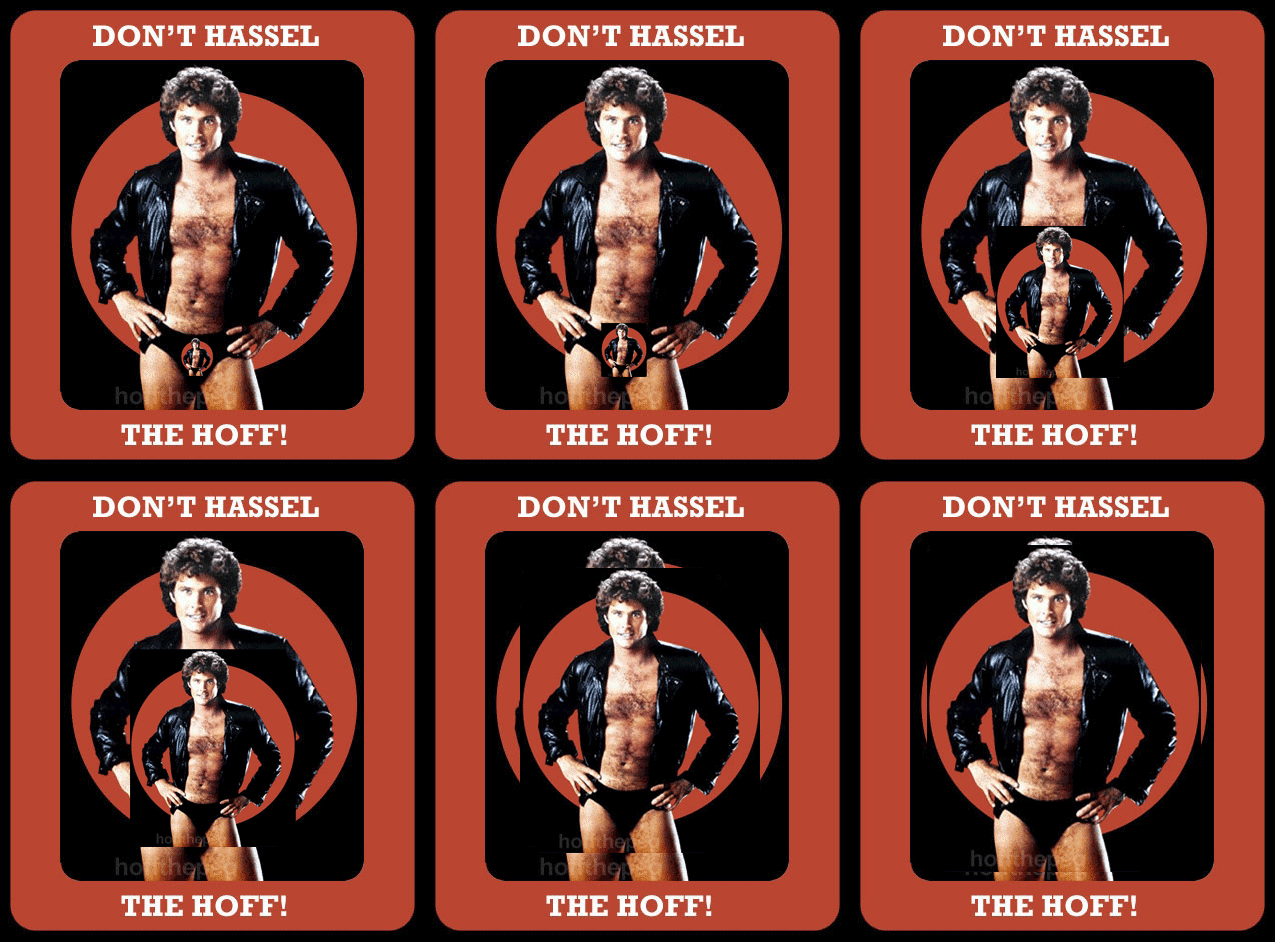
Book: Don't Hassel The Hoff


Ok, it would be a lie to say that I "read" this book... I read pages and sections but mostly skimmed it. It was pretty much unreadable. Clearly The Hoff did not use a ghost writer. Or, he used a really bad one. But given the massive weight of the HasselEgo, I'm guessing this is 100% pure Hoff.

As part of my new quest to review temptingly bad books (the kind that we so often scoff at and pass by, but not before stealthily flipping through a few pages), I'm starting off with Don't Hassel The Hoff, by none other than The World's Most-Watched TV Star himself, David Hasselhoff. Who doesn't know who David Hasselhoff is? He first met success as Dr. Snapper Foster on The Young and the Restless in the 70s. Then, his groundbreaking, action-packed (yet family-friendly) show Knight Rider was a super hit in the 80s. In the 90s, the uber-California Baywatch was shown in nearly every country around the globe. Mr. Hasselhoff was also an international rock star by this time as well, although he remained generally unknown to the elusive American music market. Nowadays he spends his time on Broadway, visiting dying children, and visiting the fine folks at Betty Ford.

In this autobiography, The Hoff shows that he is "much more than a hunk with a great tan and blue eyes (who can still fit into tight leather pants)"... or, let's see, is he "more than a guy who talked to a car, more than a guy in red Speedos running in slow motion across a beach"?

He is. He is much more than all of that. He is The Hoff. The Man With A Tan. The Hoffster. Friend of Liberace, Princess Diana and Lou Rawls. A rock star with more than 20 albums (including Night Rocker, Lovin' Feelings, Everybody Sunshine and More Than Words Can Say). The man gets around.

A few of my favorite quotes (not including the awesome one about the avocado tree and the wiener):

"When people stop me in the street today, nine times out of ten it's because of Knight Rider. It was a show about heroes, about a man who could change things, about a man who helped others. The Knight Rider slogan was, "One man can make a difference." I truly believe that I got the role of Michael Knight for a reason. I was given a power that could be used in a positive way, far greater than anyone could imagine, to help sick and terminally ill people, mainly children who watched the Knight Rider programme and believed in its hero."

Don't you like how he spelled "programme" with the extra M and E at the end? It makes it look more international, don't you think?

"I had been in South Africa for only twenty-four hours when I noticed that black South Africans would always shake my hand in such a way as to show they had no weapons up their sleeve. I walked on to a segregated bus, even though people warned me not to. I said to myself, "Hasselhoff can't go on that bus but Michael Knight can." To the consternation of the security guards, I boarded the bus. Every passenger was black and they began hugging and kissing me; everyone wanted to shake my hand."

International bringer of peace! Risking his life for international camaraderie!

"I accepted an offer from K-tel to make a new album entitled Lovin' Feelings, a complilation of love songs that was a complete change of pace from Night Rocker. Having succeeded in selling items like non-stick pans on television, K-tel was now marketing albums of past and present hits to consumers through flashy, high-powered TV advertising campaigns. Lovin' Feelings was to follow this formula. I would cover songs such as, "Always On My Mind," "Stand By Me," and "How Deep Is Your Love," plus a couple of numbers in Spanish to attract the big Hispanic market."

Bringing quality music to the masses!


"With bombastic sound and heavy fog, suddenly the door of a pyramidal tent, made of white satin, opens up. Slowly KITT rolls on stage and David is standing on his roof in a black leather outfit and playing a red guitar. He starts to sing the first song from his first LP, Night Rocker. Then he slowly slides down to the ground and asks, "Would you please say hi to my friend?" The whole hall was raging. The red light in front of KITT starts to blink, a sign that he wants to say something. The crowd is screaming, "We love you KITT!" and KITT answers, "I love you, too!" Then KITT starts reporting about their trip to Austria in German. He even teases David, "Hey David, why don't you speak German?"

You can feel the impact of his awesomeness even in third person!!

"Playing the ditzy blonde bimbo for all it was worth, Pamela (Anderson) soon had the press eating out of her hand. "I'll melt if you put me too near the radiator," she giggled. "I think I've got Tourette's syndrome, I love to talk about sex so much." The real Pamela was a clever little self-promoter. "A lot of people seem to think I'm just two boobs walking around," she said, "but I know what I'm doing." In her spare time, she meditated and read Carl Jung. She kept crystals in her trailer as a means of producing good karma and brought her golden retriever Star on the set for good luck. She was a free spirit, part rock chick, part earth mother."

And a darned nice girl, too. Perhaps a student of The Hoff school of self-promotion?

David Hasselhoff. What hasn't he done? He single-handedly created the success of Knight Rider by touring with a black Trans Am (um, for decades, apparently). He satisfied his legions of fans by routinely carrying signed pictures of himself to hand out in the streets as he walked to work (so thoughtful!). He flirted with Princess Di at her charity function (lover-boy!). He had Liberace over to dinner at his parents house (tolerant!). He is The Man. He saves children's lives.

Well, he doesn't really do that, but he answers their dying wishes by bringing Michael Knight to sick children the world over.

After a healthy skim of Don't Hassel The Hoff, a few things are clear:
1. David Hasselhoff is a powerhouse of self-promotion.
2. He is not unaware of his status as a kitsch icon, and seems to have a sense of humor about it.
3. He has a massive ego.
4. He truly believes that Michael Knight and KITT were sent from Heaven to help save the children.
5. Even SpongeBob loves The Hoff. How can you not love The Hoff?

(all snarkiness aside, he seems to do an amazing amount of sick-children visits)

One closing line:
"...with my wiener dogs in tow, I walked down the drive of my home in my underpants to get the newspapers. ... (after reading the headline) I looked down at my wieners and said, "This isn't a good sign."

I leave you with The Hoff and one of his wieners. Enjoy!

Wednesday, February 17, 2010

Book: Blankets

Hot on the heels of fantastic novel #1 (Never Let Me Go), we have Fantastic Novel #2, a graphic novel this time. Oh, what a beautiful piece of art this book is.

I'm not really into graphic novels per se. I like a few (Strangers in Paradise, Sandman), but I haven't really gotten into them as a thing.

You definitely do not have to be a fan of graphic novels to be incredibly, deeply moved by this lovely, lovely story of first love, growing up, bonding between siblings, religious journeys and the inevitable pain of all of it.

So many other people have written incredible, eloquent reviews of Blankets, and I don't know what I could say that would add to the adoration.
* Lu
* Ana

As Ana says, "Dear friends who haven't read Blankets yet: please read it right now. I'm serious. And if you're thinking, "Could it possibly be as good as everyone says it is?", the answer is yes - as good, if not better."

I took her advice (and everyone else's) and I'm so glad I did. The story is incredibly touching. The art is wonderful. The story arcs are simple and clean and absorbing... it was crazy easy to read this in one sitting, completely blocking out the rest of the world.

Craig Thompson is the narrator (and author and artist) in this autobiographical account of growing up sharing a bed with his little brother (hilarious, moving, sad, scary, wonderful) and then later, falling in love for the first time, sharing a bed with someone for the first time (hilarious, moving, sad, scary, wonderful). The anguish and tension of first love, being a teenager, struggling with questions of faith and friendship and love and growing up.

Since everyone else has written such amazing things about it (and I'm very tired tonight and can't seem to pull up the words I want to write), just a few personal thoughts about it.

While I didn't have to sleep in the same bed as my little brother, we did have a great time having 'sleepovers' in each other's room sometimes, which I now look back on as such sweet, fun times. He and I both also battled a terrific fear of the dark (ghosty house), sleepwalking (sometimes in tandem), and developed a keen eye for looking out for each other as we navigated childhood camping, fishing, skiing, etc. Now both in our 30s (crazy) we are very close. The sequences about wanting to protect his little brother (and sometimes, not being able to) just shot me right through the heart. I love my brother intensely and the painful scenes in Blankets just made me want to weep.

I'm sure everyone's first experience with love is different, but I think everyone can find something to identify with as Craig and his friend Raina fall in love. That intensity, the narrow focus of only each other, the deep longing and joy. And the inevitable heartbreak when maybe somebody isn't on the same page as you. More tears.

A big thick, hefty chunk of a graphic novel, I wanted more when it was over. I might even have to read it again before it goes back to the library.

Tuesday, February 16, 2010

Book: Never Let Me Go (edited)

Oh, how I wish I could write eloquently enough to describe this beautiful, sad, strange, utterly absorbing novel.

Unfortunately, even if I could, there is a terrible dark secret that is revealed slowly over time, and it would be awful to spill the beans if anyone hasn't read it yet.

The students of Hailsham, a boarding school of sorts, are special. They have a special role to play in society, and are shielded from the rest of the world. They spend their days studying art and poetry, sharing secrets in the dorms, and struggling to navigate the ins and outs of friendship and love.

However, just below the idyllic boarding school scene runs a dark undercurrent. Like the Hailsham students themselves, we are slowly "told but not told" the secret. At first, you can't quite believe what your brain knows to be true. It seems unthinkable. As more and more is revealed, the sense of horror grows just under the beautifully written relationship drama.

However, this is far from a horror novel. It reminds me very strongly of The Handmaids Tale, that favorite (but horrible) Atwood novel. On the surface, it's beautifully written, full of longing and melancholy, lovely English countryside scenes, complex friendships. But the shadow that lurks... weaves its way through the story... we are never able to quite break contact with the shadow.

I wish I could write more about this book, but I really can't without revealing too much. The complicated friendship between the protagonist, Kathy, and her best friend, Ruth, and their close friend Tommy, is rich and layered, often painfully true to life. The melancholy theme of 'never let me go' runs parallel to the dark shadow... both of them interweaving through the story. The friends are inseparable, until, inevitably, life separates them.

Unfortunately I had to return the book to the library, because there was more I wanted to write but I can't remember the specific parts, but I can write about my reaction to what I read. I found this book to be deeply affecting. The sense of futility and loss, so closely tied to the beauty of friendship and love, was heartwrenching. When I finished, I closed my eyes, let it wash over me, walked out into the kitchen to get a glass of water, and then stood at the sink and cried. It took a few minutes for the full impact of the story to sink in and hit me. It has stayed with me and I find myself drifting into Hailsham melancholy at odd moments.

So beautiful and sad. I loved it. I now need to read Remains of the Day, also by Ishiguro.

** edited to add: I was thinking about it this morning and this book took me a few chapters to get into. It's told in this beautiful, slow, slightly hazy way, and while that works incredibly well, it took a little while for me to get into it. I liked it, but I wondered what what going on, where all this was going, in its meandering way. The rest of the book unfolds in these beautiful gentle leaps and plays between present and past, always folding and refolding and unfolding and finally blooming open.

The other thing I was thinking about was how incredibly masterful the storytelling is. By the end of the book, you are devastated. But all along the way, you are somehow buoyed into this gentle, peaceful sense that it's all somehow okay (although you know it really isn't, somewhere deep down, you know this isn't going anywhere good... although the journey there is beautiful... and maybe that's kind of part of the point of the book?).

Thursday, February 04, 2010

Book: Tales of the City

Sorry to disappoint the bad-review fans, but this book was SO MUCH FUN.

Many people have told me that Tales of the City was a total trip, so silly and fun and gossipy and local (if you're in the Bay Area, that is). It's all true! SO much fun, so SEVENTIES. Oh my goodness, so seventies.

I loved it. I loved every single chapter.

I loved the adorable snarky queeny gay characters.

I loved the fag hags.

I loved the mysterious and generous (ahem) landlady. And her sweet romance.

I loved the naive newcomers and their perceptions of this freewheeling crazy city by the bay.

I loved the gossipy, bitchy, privileged society couples.

I just loved every page.

It was really fun to read this after having lived here for over 10 years now (wow), because I am very familiar with all the landmarks, some of the history, the neighborhoods. Apparently this was written as a series of columns, very current. Armistead Maupin, the author, was able to work in current events, so I can imagine how much fun it would be to read this each week or month or however often it was published. San Francisco in the 1970s?!? I don't necessarily wish I lived it, but it sure was fun to read about.

If The Bourne Identity was unintentionally amusing because of the dated technology, Tales of the City was a time capsule of the mid-1970s and was so far behind any sort of technology at all that it was completely charming. These two books have really made me question the place of technology in our everyday lives. I'm always sort of vaguely against modern technology, even though I use and love much of it (she writes, on her laptop, with wireless internet, with Blackberry charging in the other room...). Reading these two in a row has made me think hard about how much time I spend in front of the screen(s). I think I would feel much more human and centered if I spent more time in front of the canvas, or the page. I think I'm going to try to make some changes.

Anyway, I would love to quote this entire book, but here are a few that made me laugh out loud and made me very happy.

This one cracks me up for the non-ironic use of "boogie":
"... do you think I'm a fag hag?"
"What?"
"I do, I'm sure of it."
"You've been eating funny mushrooms again."
"I don't mind being a fag hag actually. There are worse things to be."
"You are not a fag hag, Mona."
"Look at the symptoms. I hang around with you, don't I? We go boogying at Buzzby's and The Endup. I'm practically a fixture at The Palms..."
"Mona..."
"Hell, Mouse! I hardly know any straight men anymore!"
"You live in San Francisco."
...They ate dinner at Pier 54, boogied briefly at Buzzby's, and arrived back at Barbary Lane at ten-thirty."

That phrase, "boogied briefly," cracks me up. I boogie, you boogie, we boogied, they boogied, we boogie together. Not danced. Boogied.

A few other choice bits:

"Mona's second-floor apartment was adorned with Indian wall hangings, assorted street signs, and Art Deco light globes. Her dining table was an industrial cable spool. Her armchair, a converted Victorian toilet."

"Maybe it was the light show or the rock ensemble... or the Afro-aphrodisia of the Reverend Willy Sessums, bojangling the bejeezus out of Third World Socialism. Or maybe it was the Quaalude she took at breakfast. Whatever. Today she felt mellow. Together. A karmic cog in the great, sway mechanisms of Glibb (Glide) Memorial. She sang out with the fervor of a Southern Baptist, flanked by a Noe Valley wood butcher and a Tenderloin drag queen in a coral prom gown."

"...I meet some person... male-type... at a bar or at the baths, and he seems really... what I want. A nice mustache, Levi's, a starched khaki army shirt... strong... then you go home with him to his house on Upper Market, and you try like hell not to go to the bathroom, because the bathroom is the giveaway, the fantasy-killer... It's the bathroom cabinet. Face creams and shampoos for days. And on top of the toilet tank they've always got one of those goddamn little gold pedestals full of colored soap balls!"

That last one cracked me up because my grandma had one of those little gold pedestals full of colored soap balls! I loved those when I was little, I was totally fascinated and desperately wanted a little soap ball of my own.

Ohhhhh, I loved this so much. I think I definitely have to read the next one. It's the perfect antidote to modern-day angst and worry and overwhelm. Have a Quaalude, smoke a joint, go do some boogying, go pick up a lovely gay man at the Market street Safeway for some rollerskating and then a hamburger at Hamburger Mary's. Now I think I have to go do a San Francisco Tales of the City landmark tour. And watch the show.

Monday, February 01, 2010

Book: The Bourne Identity

A little background information before we jump into the review:

I do not generally read thrillers. There are a few exceptions: I love the Pendergast novels (by Lincoln & Child), and... um, well that's all I can think of. And the reason I like those is because the main character is so quirky and compelling, and because there is usually an element of the supernatural involved at some point. I also don't really like thriller movies, but Terri convinced me that I would enjoy The Bourne Identity when it was released, and I did like all three of those. There's a certain category of thriller book and movie which Terri loves, which I refer to as "Man Movies" or "Man Books." They're the equivalent of romantic comedies or chick-lit books. Usually the cover features very strong fonts, and an explosion, and people looking serious, and maybe a woman with a gun. You know the type (see: featured cover above). Anyway, The Bourne Identity was definitely a Man Book, but it was maybe Man Book Lite.

However, Terri said I would enjoy this book, and my library doesn't have it for some reason, and I was at the airport and they had a really bad selection of books but they had this one, so that's why I ended up reading this.

If you've seen the movie, you know the premise (although how it plays out differs in the movies). A man wakes up in a foreign country, severely injured, with no idea who he is or where he is or what happened to him. Complete amnesia. But he very quickly realizes that he has skills no ordinary person should have: he's great with a gun, extremely resourceful, a master of disguises, has no problem killing when necessary, and seems to have a sixth sense about who's trying to kill him. Why they are trying to kill him becomes the real question.

I have no idea how to review a thriller, because it followed what I assume to be the pretty standard format: set up premise, insert lots of guns and bad guys, race around trying to outsmart said bad guys, shoot a lot of people, involve espionage in some way, throw in a deep undercover US government operation, maybe a beautiful woman, and a nemesis. Voila: the thriller.

Anyway, I'd like to point out that this was a REALLY LONG BOOK. It was almost 600 pages. So I liked it enough to keep reading, although towards the end I was definitely skimming. I really enjoyed the first parts, when he was discovering all these really cool spy skills, and travelling all over France and Switzerland, and the part about the Swiss bank was fun. By the time he met Marie (the beautiful woman), he was starting to piece together bits of his past... but he is never quite sure exactly who or what he is. That's the big mystery. And we aren't sure either (which is fun).

By the last third, I was really ready for him to find his nemesis and get it over with. Of course we know it's a trilogy, so things aren't quite resolved, but good enough. Frankly by that point I didn't really care, I was so tired of reading this book. I doubt I'll read the next two unless I'm stranded at the airport again, or if I really need a change of pace. I did enjoy it, but it's just not my thing.

However, the thing that really struck me was the Lack Of Cell Phones. After a little while I realized that he was always racing to the pay phone and fumbling for coins. Wha? I checked the pub date: 1980. Aha! From then on, it became very amusing to notice the dated bits. The cell phone thing was a big one. How did the people in thriller book ever manage before cell phones? They are always looking for parking places (or smashing cars, making a parking space) and dealing with out-of-order pay phones, or renting hotel rooms just to use the phone, or waiting impatiently by the phone, or setting up elaborate "I'll call you at 7:17 pm SHARP" phone-relay systems. I imagine the entire world of espionage was revolutionized by the cell phone.

The other thing that cracked me up was the "glowing green screen of the wall of computer monitors." Remember when all your monitor had was blinking glowing green text? And what a huge deal it was when color monitors appeared, even in rudimentary form? Anyway, there was a serious lack of technology in this book, which strangely I think helped me enjoy it more, since I wasn't glazing over with talk of nano-this and mega-that.

Also, the HUGE SUM OF MONEY he recovered from the Swiss bank was FOUR MILLION DOLLARS!! Ok, ok, I know, if I had four million dollars that would be a pretty big deal. But I guess thirty years ago, four million dollars was more... it was enough to set you up in style FOR LIFE. Or something. I can't really make the comparison. Wait... the handy-dandy inflation calculator says that 4 million bucks in 1980 would be over 10 million dollars now. So, okay. I guess that's a pretty good chunk of change. But the way they were talking about it was as if he'd somehow managed to get a billion dollars or something.

So, it was enjoyable, and the most enjoyable parts were chuckling at the technological advances we've made in the past 30 years. However, it was really long, and had way too much international government blah blah blah undercover blah blah blah disguises blah blah blah. I liked the main character a lot, and I loved the premise, and the first half or so of the book was really fun.

Maybe I'll try the next one... next year. Or something.

Coincidentally, the night I finished up the book, the movie was playing on TV. I had it on in the background just for a bit of comparison... seriously, that whole movie is BASED on cell phones.

Friday, January 29, 2010

Book: Le Divorce

Finally a review! I actually finished this a couple of weeks ago on my Oregon trip, but wanted to wait to review it until after my book club (as it was our January book pick).

The consensus: enjoyable, but mixed reactions to various parts.

The plot is this: a young woman (Isabelle, aimless, unsure what to do with her life) from California goes to Paris to help her stepsister, who is married to a Frenchie, prepare for her second child. She is to help with their toddler, do various odd jobs, etc. She later finds out that actually her sister is supposed to be helping Isabelle find a direction in her life, under the ruse of needing her help with the baby. There are many bait-and-switch moments like this in the book. Anyway, so Isabelle is an American in Paris, and quickly becomes swept into the family drama unfolding. Roxy's (the sister) husband has left her for another woman, and drama ensues.

Among the various dramas: Isabelle's affair with a powerful, sexy much-older man; a pottery-theft operation; various other affairs by various other members of the French branch of the family; a divorce proceeding which turns ugly over a valuable painting; a missing cat; a kidnapping; a murder; a birth and a death. And lots of other stuff.

And also: French-American relations commentary; Bosnian war opinions; domestic details, funny manners misunderstandings; EuroDisney and of course amazing French food.

There's a lot in this book.

And that's where the discussion got interesting. Some people enjoyed all the various plotlines and commentaries. Others (the majority) felt that many of them were extraneous and could have easily been left out. And then we had to discuss what point was being made by including so many plotlines, especially when mixed with beautiful prose and so many scenic, leisurely American-in-Paris scenes. Was it a slice-of-life? Or an overly-ambitious author?

I enjoyed the book but felt it was a little busy. There was a big dramatic event near the end which I felt could have been left out entirely. Although I didn't really find anyone particularly sympathetic (Roxy was too hysterical, and Isabelle very self-contained), I especially enjoyed Isabelle's affair with the older man. Isabelle gains a doorway into a higher cultural experience through this affair, and learns a lot about what sort of person she is and what sort of paths might become available to her. I don't have a problem with May-December romances in general, and could totally see how an adventurous young woman might stand to gain a lot (and enjoy a lot) by entering into this arrangement, especially if it's not forever, you know? It's a classic: she benefits from his attentions, his wealth, his connections. He benefits from her youth, her beauty, her freshness. They both have a good time. It's Paris! Why not?

This was definitely a fun, good read, although somewhat more complicated than it needed to be. It's a few steps above typical chick-lit, which I generally can't stand, but not too heavy. Had some nice language (some book club members felt the vocabulary was larger/fancier than warranted, but I appreciated an intelligently-written book), and certainly any sort of cultural-commentary book about Paris is fun to read. Once character is constantly trying to "crack the code" of Parisian women: how do they do that thing with their hair? What's with the scarves? What kind of perfume is the correct perfume? Why all the fancy lingerie? All the mysteries of Parisian femininity. I enjoyed those parts and wanted more.

So, overall, pretty interesting with lots of fascinating details about Parisian domestic life. With a bunch of other plotlines thrown in.

It's funny, I finished this in the airport and so had to buy another book. The book selection was TERRIBLE so I bought The Bourne Identity, which I've sort of wanted to read for awhile but my library acutally DOES NOT HAVE (how can they not have this?!), so I felt okay about buying it. It's also set in Paris, and is kind of incredibly long (well over 500 pages, but I will finish it tonight), but of course is a very different book from Le Divorce. Still, they have some similarities. While The Bourne Identity is what I would call a "man-book" (and of course there are also "man-movies"), it's somewhat better than what I typically think of as a man-book/thriller. Le Divorce could possibly be labeled as "chick-lit", but it was definitely a step or two above typical beach fluff. It's enriched fluff. Kind of like whole-grain Wonder bread.

I think I would like to watch the movie, although the sisters in the book have dark hair and in the movie, they are both blondies. Still, I'd like to see it.

Next up: Finishing Bourne, then finishing Tales of the City, and then perhaps The Song Is You or Ghost In Love or Never Let Me Go (next month's book club pick, chosen by me). So many good books in the pile. Such a good feeling.

Sunday, January 10, 2010

Book: Floor Sample (by Julia Cameron)

I shouldn't be reviewing this right now; I'm really tired and bound to be slightly crabby about this rather odd memoir.

Julia Cameron is the author of The Artist's Way as well as about a bajillion other works of fiction, non-fiction, plays, musicals, essays, etc. She has had quite a life (an understatement).

The book follows Julia from childhood through present(ish), through two marriages (one to director Martin Scorsese, and the other to Mark Bryan, collaborator on The Artist's Way), alcoholism and drug addiction, professional despair and great success, moving from Chicago to New York to Los Angeles to Taos to New York to Chicago to Taos to New York to Los Angeles to Chicago... (you get the picture), and finally psychotic episodes and a return to (shaky) sanity.

What a ride.

I liked The Artist's Way, but I find her style of writing to be a little... choppy? Over-simplified? I don't know... it's easy to read, but not at all lyrical. Maybe perhaps because her life has been so jam-packed with events and ups and downs, she seemed to skip or gloss over certain events (such as the development and impact of The Artist's Way), while long passages were devoted to her lapses in sanity (which, to be honest, were pretty interesting).

The book is both extremely linear and very muddled. I don't know -- the content was interesting, but I didn't love the writing style.

However, let me tell you, this lady is the EXPERT at "pulling a geographical." When life gets rough, just pull up stakes and haul ass to New York, or Los Angeles, or Taos, or Chicago. I lost track of how many cross-country moves she undertook... often traveling to a place "on vacation" and then just never returning home -- just having her things packed and shipped. That's one way of (not) dealing with life, I guess.

I kept reading because the course of her life was pretty interesting, but I can't say I loved the book. While undoubtedly extremely talented and gifted, she strikes me as (I hate to say it but) rather unstable in all sorts of ways. Her poor daughter Domenica gets pulled around through all these moves, and she (Julia) remains somewhat a victim to poor choices in men and an avoidance of facing facts. Which is interesting, considering that her most-famous work is based on 12-step recovery programs.

Anyway. I didn't find this very engaging, but it was an incredible account of a very creative, full, occasionally happy but ultimately kind of unsettling life. However, I do want to do The Artist's Way again. I feel like I've been through the wringer since I did it last, and I might actually "get" it this time. Maybe later this year.

Monday, January 04, 2010

Book: 12 Days on the Road; The Sex Pistols and America

Although readers on Amazon give this book at least 4 stars, I have to be a true punk and go against the mainstream and say that this book was kind of, well, boring.

How can a book about the Sex Pistols be boring? How can a book written by the Sex Pistol's tour manager be boring? That there takes real talent.

Written by Noel Monk, who was there every step of the way on the Pistols' 12-day disastrous American tour, this should have been a pretty good time (watching the god-awful bad time these poor guys all had). However, it reads like a couple of dumb, drunk frat boys decided to write an epic tale about their trip to Mexico over the summer.

It's also very confusing, as it skips between present tense ("We are all on the road to Tulsa. Johnny looks out the window and makes yet another caustic remark.") and various other tenses, as the authors see fit. I also didn't like how there are entire conversations transcribed as if someone had had a tape recorder at the time, complete with "yeah" and "um" and so on. If the band and crew were as drunk as they say they were on the tour, there is no way they could have remembered the conversations 15 years later. That sort of thing annoys me. Especially when it's written in present tense, which should have some kind of excitement pushing things forward. Instead, the entire text is dead boring.

The author(s) are also omniscient, which bothers me in a nonfiction text. How could they know what ALL the band members and crew are thinking? In present tense? Annoying.

However, terrible storytelling style aside, the actual event of the Sex Pistols American tour is a pretty fascinating thing. The Sex Pistols as a group are totally fascinating. Were they a real band at all? Or a twisted version of today's formulated boy bands? Was Malcolm McLaren really as much of an asshole as history seems to present (I say yes)? Was Johnny Rotten a genius or a puppet? How in the world did four street kids come up with enough talent and attitude to pull off such a stunt as to spark an entire music revolution? The entire history and mystery surrounding the Sex Pistols is so interesting. Nobody seems to know exactly what happened for the entire two and a half years they were together. One amazing album and a whole lot of mayhem and destruction. Upon reflection, if that's not rock and roll, I don't know what is.

I first heard the Sex Pistols when I was a sophomore in high school. I knew NOTHING about them, except some vague idea that they were a punk band and kind of important. However, once I heard their album I had to have my own copy, and I've loved it ever since. Although I've never exactly been an uber-punk-rocker, I've always loved punk. It makes me happy. It sparks creativity and gives me energy, and wakes me up. When I'm mad or frustrated or feel like the whole world is stupid, punk is there to say, "Hell yeah! Now go break some stuff!"

Interestingly, Sex Pistols music does not translate well to ones' car stereo. It only sounds good (to me) blasted at home in the living room or through headphones. Somehow it loses something in the car (which is where I listen to most of my music, except for when I'm doing art). I wonder why that is? Perhaps the juxtaposition of listening to raw Pistols whilst driving in a little tame Corolla proves to be too much of an insult and the music sags under the weight of embarrassment?

No matter. Even if it was a bad book, it was still fun to look at some of the pictures and to ponder the incredible contradiction that is the punk rock music industry. And to feel sorry for Sid Vicious, a tragic image of stupid self-annihilation if there ever was one. That is one point over which I agree with the book's authors: poor kid should have gotten some help, instead of being pushed off on inept handlers.

So, if you are a Sex Pistols fan or interested in punk rock history, you might as well read this book. But it's not exactly worth your time otherwise.

Sunday, January 03, 2010

Book: Death On The Nile

Ah, the first book post of the year! Actually finished this New Year's Day but am just now getting around to writing about it.

I definitely like Hercule Poirot mysteries. I haven't tried any Miss Marple yet, but the oh-so-humble (said with tongue in cheek) Monsieur Poirot is delightful.

This is another international one (like my first Christie, Murder on the Orient Express). The beautiful English heiress is on her honeymoon with her unlikely groom, on a tour down the Nile in Egypt. Coincidentally, also on the tour is famed detective Hercule Poirot, a variety of amusing secondary cast characters, and... the groom's ex-fiancee?!? This can't be good, right? Right!

What follows is a dark and murderous journey down the Nile, with stops for temples and sphinxs, and lots of danger and mystery along the way.

What I loved about this one is the generous motley handful of clues (a velvet stole, a nail polish bottle and a pearl necklace?), the full cast of quirky characters (although there were a few too many for me and I kept getting the men all mixed up), and the rather sinister feel of the story, which was a welcome change after my last Christie, By The Pricking Of My Thumbs..., which I found kind of silly.

Some random thoughts:

Were Egypt and Nile tours popular as vacations and honeymoons back in 1930s? Many references are made to other people going to Egypt on their honeymoon, and most people on the boat are there for leisure. I'm trying to remember... was that when King Tut's tomb was discovered? Maybe that was the 20s, in which case I suppose the Egypt craze might still be continuing. I also remember from my art history classes something about Egypt and Oriental art influencing Art Deco, which was 30s.

(which reminds me again that there is a King Tut exhibit at the de Young museum in San Francisco right now, and I really should go.)

Also, lots of talk from the characters about "the Orientals" and "the Oriental character." Some other slightly derogatory chatter about "the natives" (as per usual from books of this era, or most English books pre-1960s...). I was annoyed by this but tried to keep it in perspective, i.e. the period during which this was written, and also that it was partly a commentary on the unhappy, ignorant, privileged lives of the rich.

One thing I've noticed about Agatha Christie mysteries is that you are given most of the clues, but not all of the clues, so I don't feel quite so bad that I couldn't figure out the main mystery (the whodunnit). There were certain key point that Poirot pulled out of his hat in order to demonstrate his theory, and they existed only in his head, nowhere else in the story. I can't decide how I feel about that. I'm a mystery novice -- I rarely read mysteries -- but I sort of assume that it's bad form to keep clues hidden from the reader, and then to pull them out at the last moment in order to keep the mystery a mystery. Isn't part of the fun of mysteries to solve them yourself?

That said, you really do get most of the clues if you pay attention, so I was able to figure out a few of the side mysteries along the way, and the main one became clear enough right before Poirot reveals the murderer. It was a pretty satisfying solution, I suppose.

The charm of these books to me isn't the murder mystery -- mysteries aren't really my thing. It's more the era in which these are set, and all the quirky characters, and Mr. Poirot himself is pretty delightful as well. This one was perfectly cozy and engaging and a perfect way to bring in the new year. I will definitely be reading another Christie this year. Next time, perhaps Miss Marple? I also want to reread some Sherlock Holmes. I haven't seen the new movie, but I read a ton of Sherlock stories in high school and they were so satsifying!

Sunday, December 27, 2009

Book: Wintergirls

I've heard a lot about this book lately, and YA books are always good in a slump. So I read it in one go, last night.

And you know what? It was pretty great.

I had to think about it all day today to figure out what I wanted to say about it. I've read (for various reasons) many books about anorexia. This wasn't exactly original in the ground it covered, but the writing was phenomenal.

"Here stands a girl clutching a knife. There is grease on the stove, blood in the air, and angry words piled in the corners. We are trained not to see it, not to see any of it. {...body found in a motel room, alone...}

Someone just ripped off my eyelids."

Lia and Cassie are the best of friends, bound together by a love of books and secret obsessions. Something happened about six months ago, and then they weren't friends anymore. And now Cassie is dead, found alone in a motel room. And Lia begins to drown, to freeze, to whittle herself down to nonexistence. To join Cassie.

But is that what she really wants?

The writing in this book is really beautiful, and sometimes kind of brutal. Dancing on a fine line between reality and dream, between realtime and dreamtime, sanity and madness. The writing saves the book, because the story is all too familiar. Girl from well-to-do family is somehow never good enough. Dad is distant. Mom is controlling. Girl feels invisible. Tries hard, by starving herself, to make herself strong and small and perfect. But of course it never works.

The stepmother is the only character which breaks the mold. When Lia is in her downward spiral, haunted by the ghost of Cassie and determined to whittle herself down to triumphantly small numbers, stepmom Jennifer has had it up to here with the crap. When her daughter, Lia's stepsister, breaks her arm, Jennifer needs Lia to drive to the drugstore to pick up a prescription. Lia hasn't eaten in who knows how long, and isn't sure she's able to drive.

Jennifer reaches into the glass jar on the counter, pulls out an oatmeal raisin cookie the size of my head and shoves it at me. "Can we take the spotlight off you for just one minute, Lia? Put some food in your mouth, quit whining, and go to the damn drugstore."

I wanted to cheer. I liked Lia, actually. I felt sympathy for her illness and the desire to annihilate herself. But when you're 18 and you have your whole life ahead of you and sure, you and your family has issues, but who doesn't? -- I have to say I was losing patience with it. On the one hand, I get it. I get what anorexia is. It's an illness. It's an addiction. It's someone doing the best they can to do what they think they have to. But on the other hand, maybe I've just outgrown a certain degree of my own body issues, and maybe I've had a little taste of what real-world problems are, but another part of me felt like Lia was self-centered, selfish, stubborn, and self-destructive. She wants to die, end of story. Until she wants to live, there's not much anyone can do about it. I was glad that the book says as much. Lia could go to treatment for a third time, but unless she actually wants to live, really live, nothing's going to change.

So does she? You'll have to read the book to find out.

The writing was truly beautiful and the story was good, although if you've read The Best Little Girl In The Whole World or any other "the thinner is the winner" anorexia books, you'll not learn anything new here. However, Lia is sympathetic and her family is drawn realistically, and then there's that awesome writing.

Once I closed the book, I took a deep breath of gratitude that finally, at age 35, I feel mostly at peace with my own body, and can truthfully say I don't worry about it very much anymore (with very occasional flares of freakout, which thankfully only last a few hours at most). I feel like I waited all through my 20s for this body-acceptance that everyone said would come when you're over 30. It took a few years, but I'm awfully glad I feel okay about myself now. What a freaking relief, what a burden of self-absorption to have lifted.

Wintergirls doesn't break any new ground, but it's a beautifully written book and worth reading.